
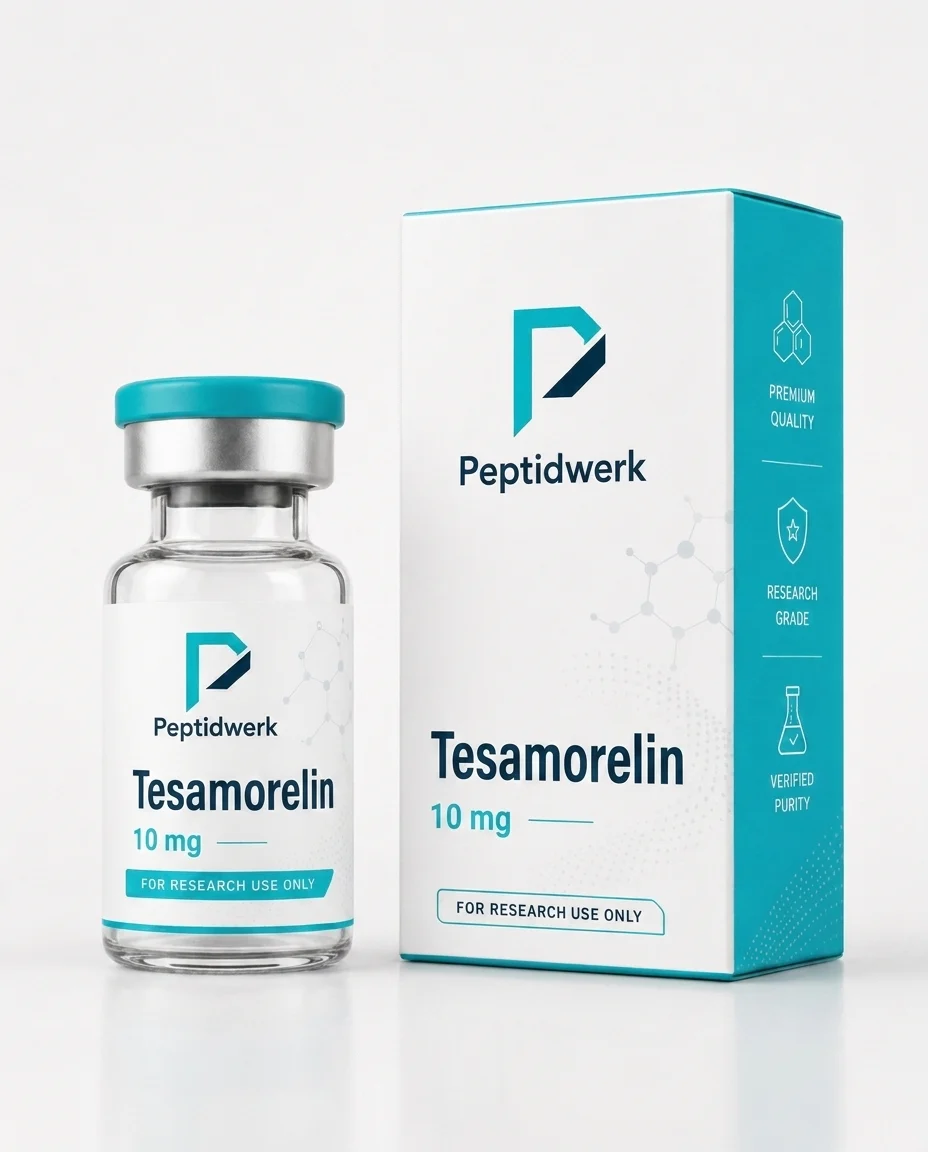
Tesa
GHRH analogue · 44 amino acids · trans-3-hexanoyl modification
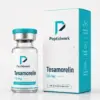
Tesamorelin is a synthetic 44-amino acid GHRH analogue (MW: 5135.86 g/mol, CAS: 218949-48-5) with an N-terminal trans-3-hexanoyl group for improved proteolytic stability. It is used in preclinical research models to investigate GHRH receptor signaling, GH/IGF-1 axis dynamics, and peptide stability. HPLC-verified, lyophilized, with batch-specific CoA. 10 mg vial from EU stock.
≥98% Purity
Lyophilized
HPLC Verified
44 Amino Acids
GHRH Analogue
CoA Included
EU Stock
For research purposes only
Tesamorelin — GHRH analogue · Synthetic peptide
10mg · Lyophilized · Research Grade · EU Stock
This product comes from a documented research batch. Available documentation includes purity testing and identity analysis by HPLC and mass spectrometry.
- Batch-specific CoA for each released batch
- HPLC-UV & mass spectrometry as analytical methods
- Sequence confirmation of the 44-amino acid chain
- CoA documents available in the product gallery
Pepwerk focuses on batch-specific documentation. New batches are tested separately before release.
Tesamorelin is a synthetic 44-amino acid peptide and a modified analogue of human growth hormone-releasing factor (hGRF/GHRH). The molecule was chemically modified by attaching a trans-3-hexanoyl group to the N-terminal tyrosine residue—a peptide chemistry modification to improve proteolysis stability and half-life in biological matrices.
As a synthetic GHRH analogue, tesamorelin is a precise tool molecule for the study of GHRH receptor signaling pathways, GH/IGF axis dynamics and comparative peptide stability in controlled laboratory environments.
Molecular properties
| Peptide type | GHRH analogue · 44 amino acids |
| molecular formula | C₂₂₁H₃₆₆N₇₂O₆₇S |
| Molecular weight | 5135.86 g/mol |
| CAS number | 218949-48-5 |
| PubChem CID | 16137828 |
| modification | trans-3-hexanoyl group at the N-terminus |
| Half-life | 26–38 minutes (preclinical data) |
| Bioavailability | ≤ 4% (subcutaneous) |
| metabolism | Proteolysis |
Research context
Tesamorelin is among the best-characterized synthetic GHRH analogs in the research literature. As a tool molecule for preclinical studies, it is used in the following research areas:
- GHRH receptor signaling and downstream endocrine dynamics
- GH/IGF-1 axis regulation in in vitro and in vivo models
- Lipid metabolism and fat distribution in preclinical animal models
- Peripheral nerve regeneration in preclinical models
- Neurodegenerative research models and CNS signal transduction
- Cardiovascular parameters and lipid metabolism in cell culture models
- Comparative stability studies of synthetic GHRH analogues
- Analytical characterization of N-terminally modified peptides
Scientific background: Tesamorelin (CAS 218949-48-5) is a well-characterized synthetic GHRH analog with documented receptor binding affinity and signal transduction data. Published in vitro and in vivo research data on GHRH receptor activation, GH secretion, and signaling pathways are available in the linked scientific databases.
All research areas mentioned refer exclusively to in vitro and in vivo research data. None of the information provided constitutes a medical indication or therapeutic claim. The product is intended solely for research purposes.
Specifications
| material | Tesamorelin · GHRH analogue · 44 AS |
| One size fits all | 10 mg Vial |
| form | Lyophilized powder · sealed vial |
| purity | ≥ 98% (HPLC) |
| documentation | Batch-specific CoA available |
| Analysis method | HPLC-UV / Mass spectrometry |
| storage | -20°C recommended · protected from light · dry |
| durability | 24 months in lyophilized form when stored correctly |
| Inventory | EU Stock · Shipping from Germany |
| Designation | For research use only |
Catalogue research reference
Typical non-clinical laboratory workflows for Tesamorelin Research Grade include:
- GHRH receptor binding affinity studies in cell culture systems
- GH secretion assays in pituitary cell lines
- IGF-1 signaling pathway studies in liver models
- Lipid metabolism research in adipocyte cultures
- Comparative evaluation of synthetic GHRH analogues
- Analytical method validation and peptide characterization
- Stability studies of N-terminally modified peptides
All examples are purely descriptive. Use only within authorized laboratory environments according to local SOPs.
External Reference Databases
- PubChem CID 16137828 — Tesamorelin molecule entry
- Google Scholar — Tesamorelin Research Index
- ScienceDirect — GHRH Receptor Research Overview
Links are provided solely for neutral contextual information. This is not a medical recommendation.
FAQ — Handling & Procurement
What is Tesamorelin?
Tesamorelin is a synthetic 44-amino acid peptide (MW: 5135.86 g/mol, CAS: 218949-48-5) and modified GHRH analogue with a trans-3-hexanoyl group at the N-terminus for improved proteolysis stability.
What is the difference to natural GHRH?
Tesamorelin contains the complete 44-amino acid sequence of human GHRH plus a trans-3-hexanoyl group at the N-terminus. This modification improves proteolytic stability and extends the half-life compared to native GHRH.
How should Tesamorelin be stored?
Lyophilized at -20°C, protected from light and stored in a dry place. Stable for 24 months if stored correctly. After reconstitution, store at 4°C and use promptly.
Where can I find the CoA documentation?
On the CoA page or in the product gallery. Each batch has its own certificate of analysis with HPLC data.
What is the purity level of the product?
≥ 98% by HPLC-UV analysis, confirmed by an independent third-party laboratory. Exact batch-specific values in the CoA.
Is the product intended for human consumption?
No. For research purposes only. Not for human or animal consumption, no medical or therapeutic use.
| Gewicht | 0,005 g |
|---|
Schreibe die erste Rezension für „Tesa“
Ähnliche Produkte

Research Peptides
Research Peptides

Research Peptides
Research Peptides
Research Peptides
Research Peptides
Research Peptides

Research Peptides
Rezensionen
Es gibt noch keine Rezensionen.